
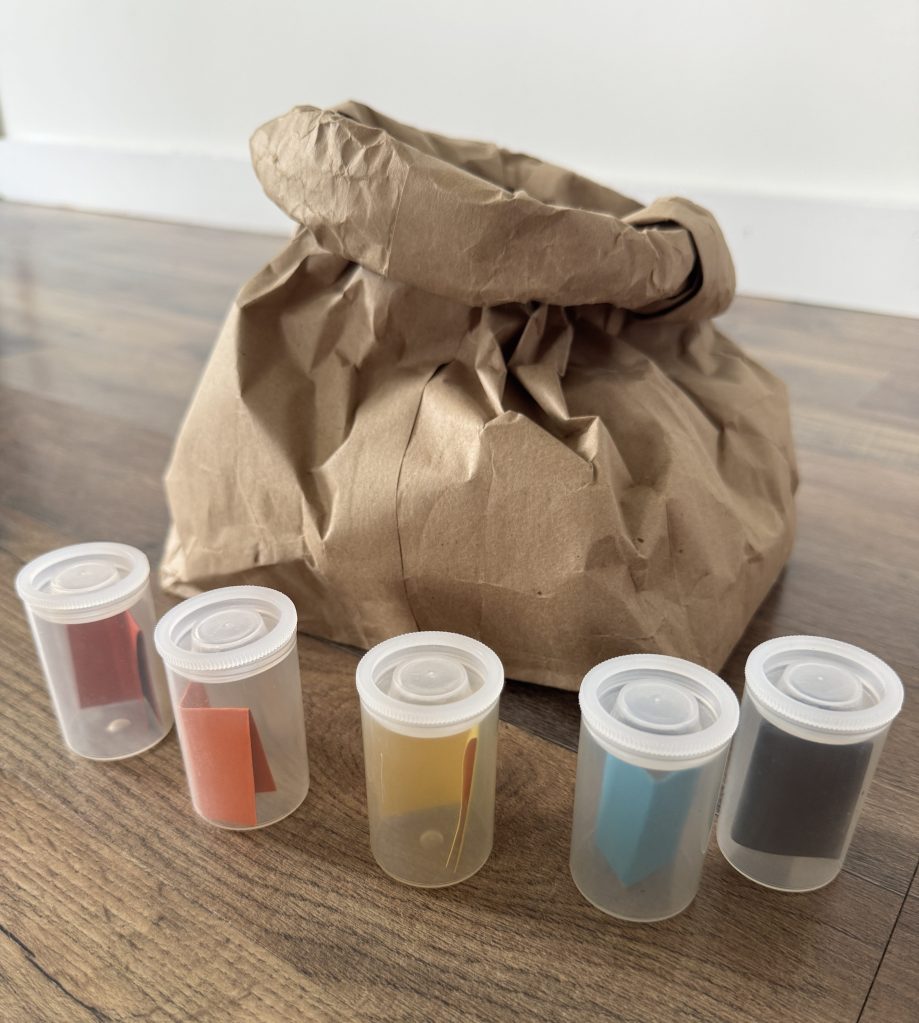
The magic of this activity isn’t an elaborate setup. It’s the tiny pause before the lid pops off and the moment when children wonder, What’s hiding inside?
That little bit of mystery draws children in, while the simple routine gives them a playful way to practice letters, language, fine motor skills, turn taking, and more.
What You’ll Need
This post contains affiliate links. As an Amazon Associate I earn from qualifying purchases, at no additional cost to you.
- Film canisters with lids
- Small paper pieces that are handwritten, printed, or cut from cardstock
- Sharpie Markers
- A small basket or container to hold the canisters. I rolled the top of a paper bag down
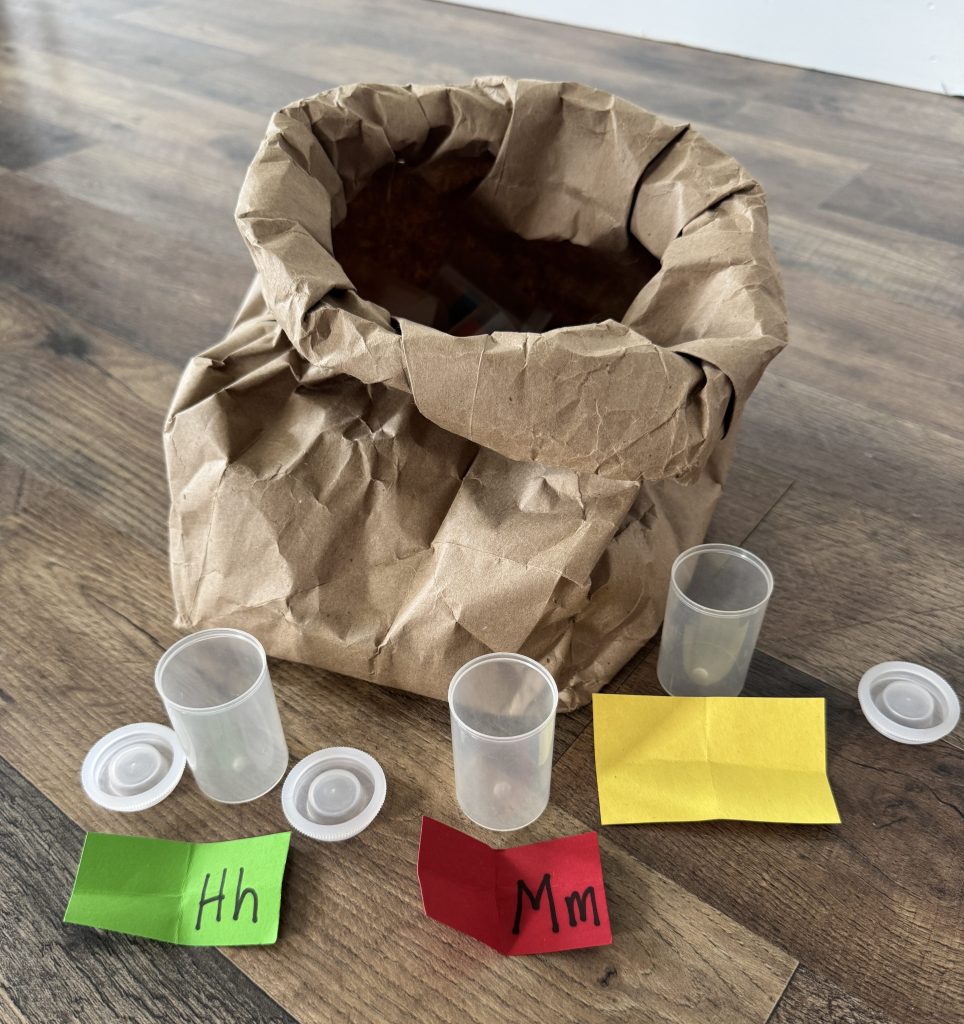
Place one paper inside each canister and snap the lids closed. You can use uppercase letters, lowercase letters, letters from children’s names, or letters your group is currently exploring.
Begin With Wonder
Start by bringing the closed canisters to circle time without immediately explaining what is inside.
Shake one. Look curious. Let the children wonder.
“What do you think could be hiding in here?”
That moment of anticipation matters. Curiosity creates a reason to look, listen, and participate before the lesson even begins.
Then introduce the routine:
Pick it. Pop it. Say it!
A child chooses a canister, pops open the lid, and names the letter inside. Depending on your group, you might also invite them to make the letter sound, name a word that begins with it, or find a matching letter.
Teach the Game Before Expecting the Game
Before passing out the canisters, model how the activity works and make the expectations clear.
Show children how to:
- Choose one canister
- Open it carefully
- Look at what is inside
- Say the letter
- Return the letter and replace the lid
- Wait while someone else takes a turn
This part may feel small, but it is what helps the activity become something children can later use independently.
They aren’t only learning letters. They’re learning how to participate in a shared game, handle materials, follow a familiar sequence, listen to others, and wait for a turn.
Move It to a Table Center
After children have learned the game at circle time, place the canisters at a table during free play.
This is where the activity becomes even more interesting.
You may hear children repeating your words:
“Pick it. Pop it. Say it!”
They take turns, remind one another of the steps, ask their friends questions, and begin playing teacher. They aren’t simply copying circle time—they’re practicing language, memory, leadership, cooperation, and classroom routines through play.
Re-enacting a familiar experience also gives children the confidence to participate in ways they may not have during the original group activity.
The child who quietly watched at circle may become the one leading the game at the table.
The Learning Inside the Canisters
Opening and closing the lids strengthens fingers and hands while building coordination. Picking up, unfolding and folding the small letters adds another layer of fine motor practice.
Children may also be developing:
- Letter recognition
- Vocabulary and expressive language
- Listening and following directions
- Memory and sequencing
- Turn-taking and patience
- Confidence speaking within a group
- Cooperation
- Problem-solving and persistence
The learning doesn’t come from drilling children on the “right” answer. It grows through repetition, curiosity, conversation, and the chance to try again.
A Simple Assessment Opportunity
As children play, observe rather than interrupting every turn with questions.
Notice:
- Which letters they recognize independently
- Whether they connect letters with sounds
- If they recognize letters from their own name
- Whether they can follow the game’s sequence
- How they approach a lid that is difficult to open
- If they wait, share, and respond to their peers
- Whether they sort, match, or create their own rules
- How their participation changes between circle time and free play
Those small observations can tell you far more than a stack of flashcards—especially when children are relaxed, engaged, and leading the play themselves.
Change What’s Inside
Once the routine is familiar, keep the wonder going by changing the contents.
Try adding:
- Colors
- Letter sounds
- Numbers
- Shapes
- Beginning-sound pictures
- Children’s names or photos
- Simple sight words
- Items to sort or match
The container stays the same, but the learning can grow right alongside the children.
Sometimes the most engaging materials aren’t complicated. They simply invite a child to wonder, participate, and come back for another turn.
Pick it. Pop it. Say it!
🌱 Stay rooted. Guide wonder.


Leave a Reply